AC installation Melbourne FL: sizing comes before equipment
The single decision that determines whether a new system performs is its capacity, and in a humid climate the failure mode of guessing is not the one people expect. An undersized system runs constantly and cannot reach the setpoint on the hottest afternoons, which is obvious and gets corrected. An oversized system reaches the setpoint quickly and shuts off, which looks like success and is not: the coil never runs long enough to condense much water out of the air, so the house ends up cold and damp, and the compressor accumulates far more starts than it was built for.
A load calculation replaces the guess. It works from the building as it stands, taking floor area and volume, window area and orientation, insulation, infiltration and where the duct runs. In a house whose windows or insulation have been improved since it was built, the correct capacity is frequently smaller than what is being replaced, which is not what most people expect to hear.
AC replacement Melbourne FL: what a changeout includes
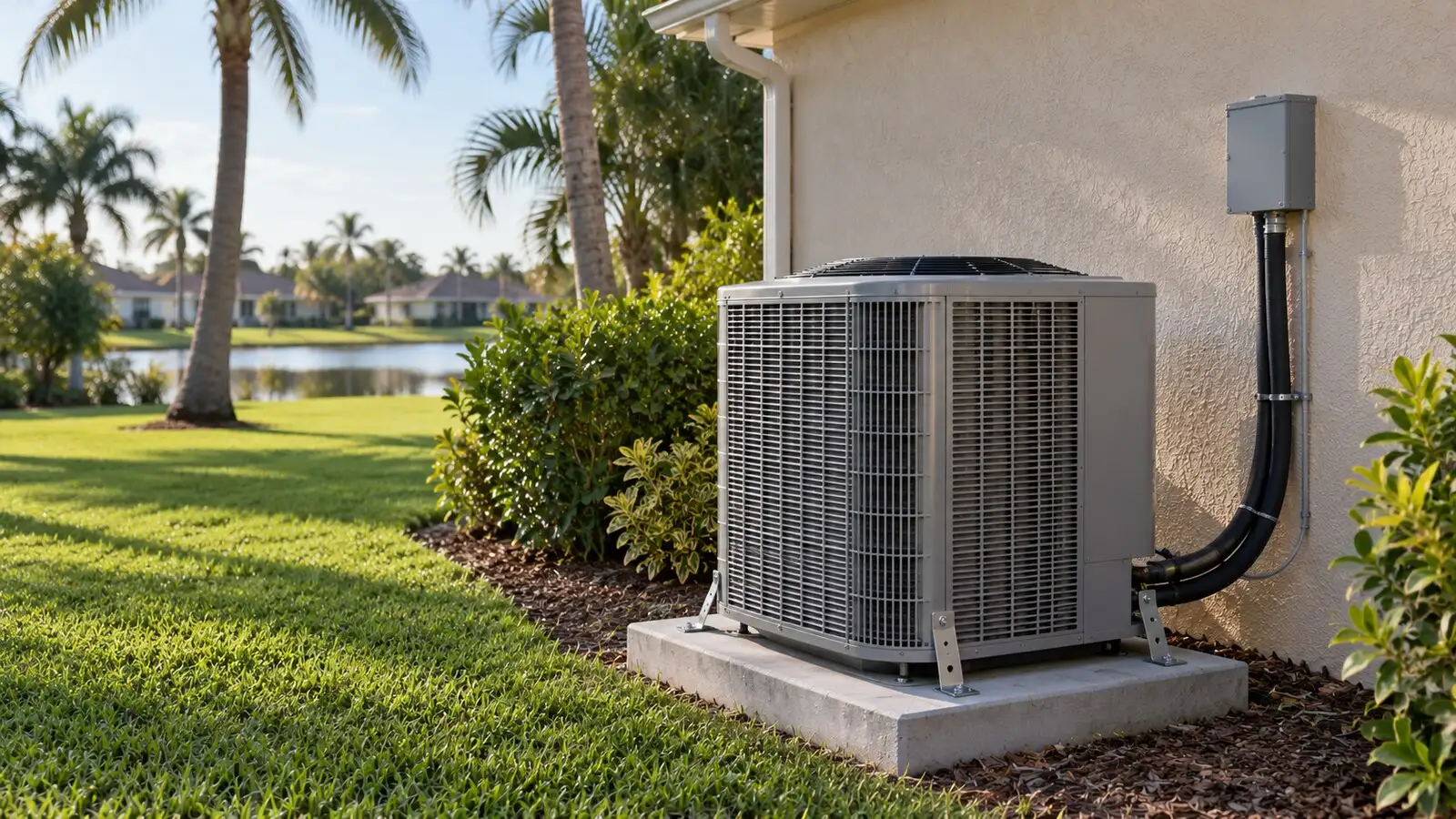
A replacement is not the outdoor unit alone. The scope that produces a system worth its rating runs to the matched indoor coil or air handler, the line set inspected and either reused after flushing and pressure testing or replaced, the condensate drain and its safety switch, the equipment pad and its anchoring, the electrical disconnect and whip, and a thermostat capable of controlling what has been installed. Duct is a separate question answered by measurement, and on older housing it is frequently the component limiting what any new equipment can deliver.
R-454B on a 2026 replacement
New residential air conditioners and heat pumps have been manufactured for R-454B since the start of 2025, replacing R-410A on global warming potential grounds, and Florida wrote the provisions for these refrigerants into a supplement to the 2023 Building Code with a requirement to comply with ASHRAE 15. For a replacement this means the new outdoor unit, the indoor coil and the metering device are matched to a refrigerant the existing system was not built around, which is one more reason a partial changeout tends to disappoint.
It does not mean a working R-410A system has to be replaced. That equipment remains serviceable and can be recharged. The point at which the calculation changes is a substantial leak, because R-410A has grown considerably more costly per pound, and a system needing a full charge more than once is a system whose repair bill has begun competing with a replacement.
AC installation permits, inspection and wind anchoring
Chapter 489 of the Florida Statutes requires a licensed contractor to obtain a permit before installing, removing or replacing an air conditioning system, and the work is inspected afterwards. Brevard County takes residential mechanical permit applications through its online contractor portal, and the municipalities within the county operate their own building departments, so a Melbourne address may fall under either depending on where the boundary runs.
The Florida Building Code also has something specific to say about the unit outside. Mechanical equipment and appliances exposed to wind must be designed and installed to resist the wind pressures determined under the building code, which in practice governs how the condenser is anchored to its pad and what that pad is. Equipment installed on rated stands, platforms, curbs or slabs in accordance with the code is deemed to comply. On a coastal county this is not paperwork: an unanchored condenser is a projectile.
When the address calls for coastal specification
Manufacturers define coastal installations by measured distance from tidal water, with thresholds that commonly fall in the first thousand feet, the first mile and the first two miles, and they frequently make coated coils, corrosion-resistant hardware and appropriately jacketed line sets a condition of warranty coverage rather than an option. Every address on the barrier island falls inside those thresholds; Palm Bay and western Viera do not. The coastal corrosion page sets out what the specification covers.
Air conditioner repair or replacement
The question resolves into three numbers: the cost of the repair being proposed, the age of the equipment, and the cost of replacing it. A capacitor or contactor on a young system is a repair without argument. A compressor or a leaking evaporator coil on equipment past twelve to fifteen years, or past ten to twelve on the island, is usually a replacement, because the next failure is the same order of cost and the labor gets spent twice. Between those two poles the honest answer comes from readings rather than opinion, and it should arrive in writing.
AC installation Melbourne FL and across South Brevard
- AC Installation Melbourne
- AC Installation Palm Bay
- AC Installation West Melbourne
- AC Installation Rockledge
- AC Installation Merritt Island
- AC Installation Satellite Beach
- AC Installation Indian Harbour Beach
- AC Installation Indialantic
- AC Installation Melbourne Beach
- AC Installation Viera and Suntree
AC installation Melbourne FL: common questions
- How is the right size chosen?
- By a load calculation on the actual house rather than by matching whatever was there before. The calculation accounts for floor area, orientation, window area and glazing, insulation levels, ceiling height, duct location and infiltration. Replacing like for like carries forward whatever error the original installer made, and in this climate the common error is oversizing, which produces a house that is cool and damp because the system never runs long enough to dehumidify.
- Does the indoor coil have to be replaced too?
- In nearly every case, yes. Outdoor and indoor units are engineered, tested and rated as a matched pair, and a new condenser working through an old coil does not deliver the capacity or the efficiency either component was rated for. With equipment now built for R-454B the point is firmer still, because the coil and the metering device have to suit the refrigerant the outdoor unit was designed around. A changeout that leaves the old coil in place is a shortcut with a measurable running cost.
- What happens to the old line set?
- It is inspected and either reused after being flushed and pressure tested, or replaced. Age, insulation condition, sizing against the new equipment and the residue left by the previous refrigerant and oil all bear on the decision. On a coastal address the outdoor portion is examined for jacket damage and corrosion, since a line set that has been exposed to salt and ultraviolet for twenty years is not the component to economize on.
- How long does a replacement take?
- A straightforward single-system changeout is usually a one-day job: recovery of the old refrigerant, removal of the outdoor and indoor units, setting the new equipment, brazing and pressure testing, evacuation, charging and commissioning. It runs longer when the equipment closet or the pad has to be rebuilt, when duct work is part of the scope, or when the electrical service or disconnect needs upgrading to suit the new unit.
- Do I need a new thermostat?
- Often yes, though not always for the reason people expect. A heat pump needs a thermostat that understands auxiliary and emergency heat and can stage them correctly, and a system with variable-capacity equipment needs a control that can talk to it. An old single-stage thermostat driving a modern staged system will run it as though it had one speed, which discards much of what was paid for.