
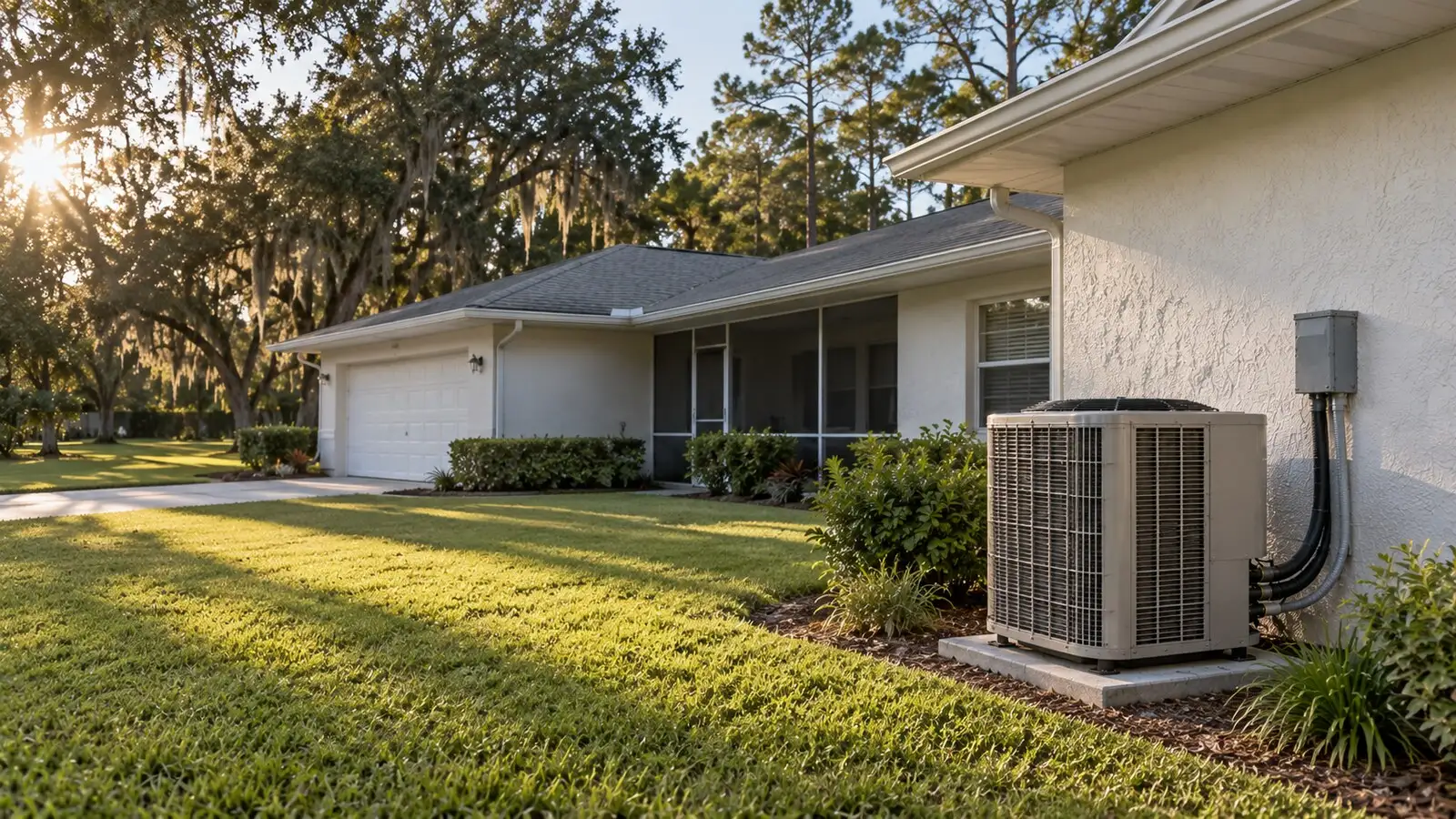
Air conditioning repair Melbourne Florida
Melbourne sits on the mainland shore of the Indian River Lagoon, about six miles from the Atlantic, with Crane Creek cutting into downtown and the Eau Gallie River meeting the lagoon on the north side of the city. The housing spans the whole range the county has to offer: concrete block ranch homes from the 1950s and 1960s around downtown and Eau Gallie, subdivision building along Sarno Road and Croton through the 1980s, and newer construction west toward I-95. The median home here dates to 1985 and 27 percent predates 1970.
What an air conditioning repair call in Melbourne turns out to be
Equipment that has outlived a coastal service life
A split system inland is generally reckoned at twelve to fifteen years, and closer to ten to twelve where the air carries salt. With a median build year of 1985, a large share of Melbourne houses are on their second or third system, and the units that went in during the 2008 to 2012 replacement wave are now reaching the same decision point their predecessors did.
Condensate drains in a 3,446 degree-day season
Melbourne records 3,446 cooling degree days a year against 485 heating. The evaporator coil pulls moisture out of the air on nearly every day of the calendar, and that water leaves through a drain line that stays wet year round. Biological growth in the trap, a tripped float switch and a ceiling stain under the air handler are routine calls here.
Air handlers and duct in vented attics
Most of the 1980s and 1990s stock here carries the air handler and the supply trunk in an unconditioned attic. On a July afternoon that space runs far hotter than the rooms below it, so every joint that leaks is losing cooled air into the hottest part of the house. Duct that was flexible thirty years ago has usually lost both its seal and its insulation value.
Capacitors and contactors through a lagoon summer
The single most common component failure on a Melbourne system is a run capacitor, followed closely by the contactor. Both live in the outdoor unit, both are electrical, and both spend the summer in air that is humid enough to hold a conductive film on their terminals. A system that hums but will not start, or starts and trips the breaker, usually points here first.
How far Melbourne sits from salt water
Melbourne's center sits roughly six miles from the Atlantic and three from the lagoon, which puts most of the city outside the band where manufacturers require coated coils, though not outside the reach of brackish air off the water. Eau Gallie and the Front Street side of downtown are the closest neighborhoods to it. Twice-yearly service is the usual interval on this side of the causeway.
Band by band: coastal AC corrosion.
Heating and heat pump repair Melbourne, FL
Melbourne logs 485 heating degree days a year, almost all of them between December and February, and 81.7 percent of homes meet them with electricity. In practice that is a heat pump running in reverse with electric strip heat behind it for the coldest mornings. Melbourne carries more gas service than most of South Brevard at 13.5 percent of households, concentrated on the older side of town.
Emergency air conditioning repair in Melbourne: how a call runs
Melbourne is the one city on this site where a technician can meet almost anything: a 1950s block house with ducting added long after it was built, a 1990s slab home with the air handler in a garage closet, and west-side construction from the last decade coming up on its first replacement.
AC installation and HVAC repair Melbourne, FL
- AC Installation & ReplacementSizing, permit, wind anchoring and the R-454B changeover.
- Heat Pump Repair & ServiceReversing valve, strip heat and defrost faults.
- AC Maintenance & Coil CleaningCoil rinse, drain line and airflow, on the right interval.
- Coastal AC CorrosionSalt pitting fins, terminals and cabinet hardware.
Areas covered in Melbourne
Providers cover Melbourne and the surrounding area, including Downtown Melbourne, Eau Gallie, Crane Creek, the Sarno Road corridor, Wickham Road, Babcock Street, New Haven Avenue and the airport district.
ZIP codes: 32901, 32904, 32934, 32935.
Air conditioning repair Melbourne Florida: common questions
- AC not cooling but the fan is still running. What has failed?
- That points outdoors. The indoor blower is on its own circuit and keeps running when the condenser does not, so the usual causes are a failed run capacitor, a contactor that will not close, a high-pressure trip on a fouled coil, or refrigerant that has leaked away. A frozen evaporator gives the same symptom from the other direction. Meters separate them in minutes.
- Why does my house feel clammy at 76 degrees?
- Because the system is removing temperature but not enough moisture. That usually means it is oversized for the house, so it satisfies the thermostat in short bursts and shuts down before the coil has run long enough to condense much water out of the air. It can also mean airflow across the coil is too high, or that the duct is pulling humid attic air into the return. All three are measurable, and none of them are fixed by setting the thermostat lower.
- Is a permit really needed to replace an air conditioner in Melbourne?
- Yes. Chapter 489 of the Florida Statutes requires a licensed contractor to pull a permit before installing, removing or replacing an air conditioning system, and the work is inspected afterwards. A quote that leaves the permit out is a quote that leaves the inspection out with it. Ask which authority the permit will be pulled from, because a Melbourne address may fall under the city or under Brevard County depending on where the line runs.
- What does a Melbourne technician check before quoting a repair?
- Superheat and subcooling to judge the refrigerant charge, static pressure across the air handler to judge airflow and duct, amp draw on the compressor and the fan motor, capacitor capacitance against its rating, and the condition of the contactor points. Those readings separate a failed part from a system that is failing. Pressure gauges alone will show that a system is low on refrigerant without showing why it is low.
- How long should a system last in Melbourne compared with inland Florida?
- On the mainland side of the lagoon the usual twelve to fifteen year expectation for a split system generally holds. The shortening happens east of the causeway, where salt in the air attacks the outdoor coil and the electrical terminals inside the condenser cabinet. A Melbourne address six miles inland is not in that band, but a system that has passed fifteen years here is still a system whose next major repair deserves to be weighed against replacement.