
Heat pump repair Melbourne FL: one machine, two seasons
Melbourne records 3,446 cooling degree days a year against 485 heating, and almost the whole heating figure falls between December and February. The county heats with electricity in 87 percent of homes, so for most households in South Brevard the heating appliance and the cooling appliance are the same equipment operated in reverse. That asymmetry shapes every fault on this page. A component that works hard for nine months and then has to perform a different job for six weeks is a component that fails at the changeover.
The reversing valve
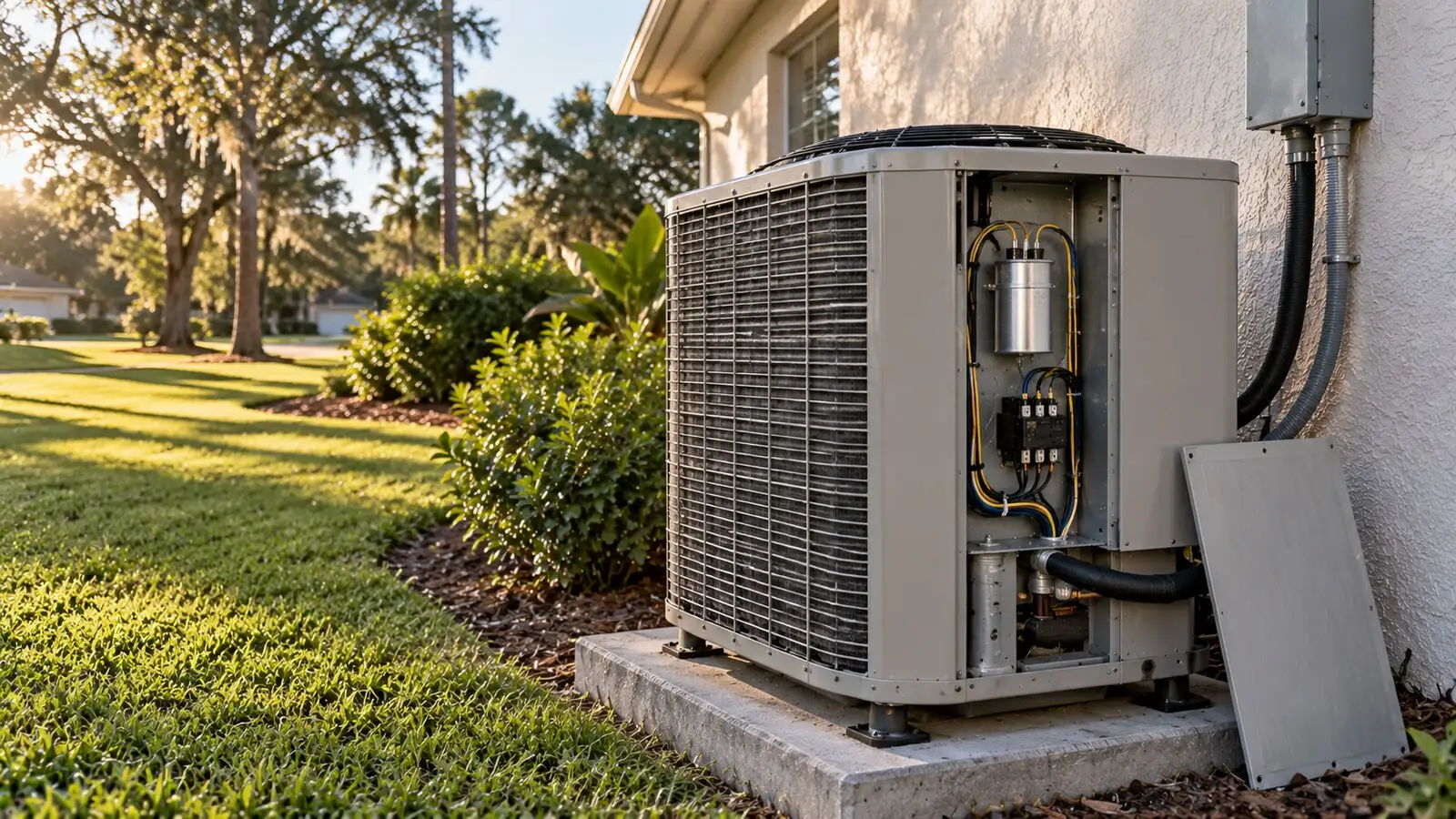
A heat pump switches between heating and cooling by reversing the direction the refrigerant flows, and a four-way reversing valve does that switching. It is a mechanical part with a solenoid, sitting outdoors, in air that on the barrier island carries chloride, and in this climate it may sit in one position for ten months at a stretch. The classic South Brevard call arrives on the first genuinely cold morning: the thermostat asks for heat, the valve does not shift, and the house warms up anyway because the resistance elements pick up the entire load.
From inside the house nothing appears wrong until the bill arrives. That is why this fault is worth finding deliberately rather than waiting for it, and why a heat pump check before the first cold snap is a different exercise from a summer tune-up.
Strip heat, auxiliary and emergency
Behind almost every heat pump in this county sits a bank of electric resistance elements, and its job is to fill the gap on the mornings when the heat pump alone cannot keep up. Auxiliary heat is the control bringing those elements on automatically. Emergency heat is a manual setting that shuts the heat pump off and runs on the elements alone, and it exists for the case where the outdoor unit has failed.
Elements that have not run since last winter fail quietly. So do their sequencers and limit switches. Because they only matter for a few weeks a year, a failed element is often not discovered until a cold morning finds the house unable to hold its setpoint, and by then the schedule is full of the same call from other people.
Defrost, in a place that rarely needs it
In heating mode the outdoor coil runs colder than the air around it and will collect frost. Every heat pump has a defrost cycle that briefly reverses the system to warm the coil and clear it, controlled by a board reading a coil sensor and, on older equipment, a timer. In Brevard those controls are exercised a handful of times a year, which is exactly the condition in which a stuck sensor or a failed board goes unnoticed. A coil that ices and stays iced is a fault, not weather.
The same box in July
In cooling the heat pump behaves as an air conditioner, and its summer failures are the ordinary ones: a run capacitor that has lost capacitance, a contactor that will not close, a condenser coil fouled with salt or debris raising head pressure, or refrigerant that has leaked away. What distinguishes a heat pump is that it carries additional components a straight-cool system does not, and each of them is one more thing that can fail: the reversing valve, its solenoid, the defrost board and sensor, and an accumulator in the suction line.
Heat pump not heating or not cooling: what gets measured
Superheat and subcooling to establish the charge, and taken in both modes where a heating fault is suspected, because a system can read acceptably in cooling and poorly in heating. Static pressure across the air handler for airflow. Amp draw on the compressor, the outdoor fan and each heat element separately, since an element that has opened draws nothing and a sequencer that has stuck closed keeps drawing when it should not. Capacitance against the rating on the can. The reversing valve is checked by commanding a changeover and confirming it happens.
Heat pump repair Melbourne FL and across South Brevard
- Heat Pump Repair Melbourne
- Heat Pump Repair Palm Bay
- Heat Pump Repair West Melbourne
- Heat Pump Repair Rockledge
- Heat Pump Repair Merritt Island
- Heat Pump Repair Satellite Beach
- Heat Pump Repair Indian Harbour Beach
- Heat Pump Repair Indialantic
- Heat Pump Repair Melbourne Beach
- Heat Pump Repair Viera and Suntree
Heat pump repair Melbourne FL: common questions
- Why does the outdoor unit run in winter?
- Because a heat pump heats by moving heat rather than making it, and the outdoor coil is where that heat is collected. In heating mode the refrigerant flow is reversed so the outdoor coil becomes the evaporator and the indoor coil becomes the condenser. A system whose outdoor unit sits still through a cold snap while the house still warms up is almost certainly running on its electric resistance elements alone, which is a fault rather than a design.
- What is the difference between auxiliary heat and emergency heat?
- Auxiliary heat is the resistance element coming on automatically to assist the heat pump when the heat pump alone cannot keep up. Emergency heat is a manual setting that shuts the heat pump off entirely and heats on the elements only, intended for use when the outdoor unit has failed. Leaving a thermostat in emergency heat because the house feels warmer that way runs the most expensive heat available and hides whatever is wrong outside.
- Is a heat pump worth having for a Florida winter?
- The heat pump is already there. In this county heating and cooling come out of one machine, and the cooling season alone justifies the equipment, so the heating capability arrives with it rather than being bought separately. Brevard records 485 heating degree days a year against 3,446 cooling, so the heating load is genuinely small. The argument for adding a separate fuel and appliance for a season that lasts a few weeks is correspondingly weak.
- Why is the power bill high only in January?
- Almost always because the resistance strip heat is carrying more of the load than it should. That happens when the heat pump is not producing heat, when the reversing valve has not shifted, when the outdoor unit is low on refrigerant, or when the thermostat is calling for auxiliary heat too eagerly because of how it was configured. All four look identical from inside the house: it is warm, and the bill is large.
- The system is icing up outside in December. Is that normal?
- Some frost on the outdoor coil in heating mode is expected, and the system is designed to clear it with a defrost cycle that briefly reverses to warm the coil. What is not normal is ice that stays, grows over a day, or forms in a thick sheet. That points at a defrost control, sensor or reversing valve fault, and continuing to run a heat pump under a solid ice load will damage the outdoor fan and the coil.