Coastal AC corrosion: what chloride does to a fin pack
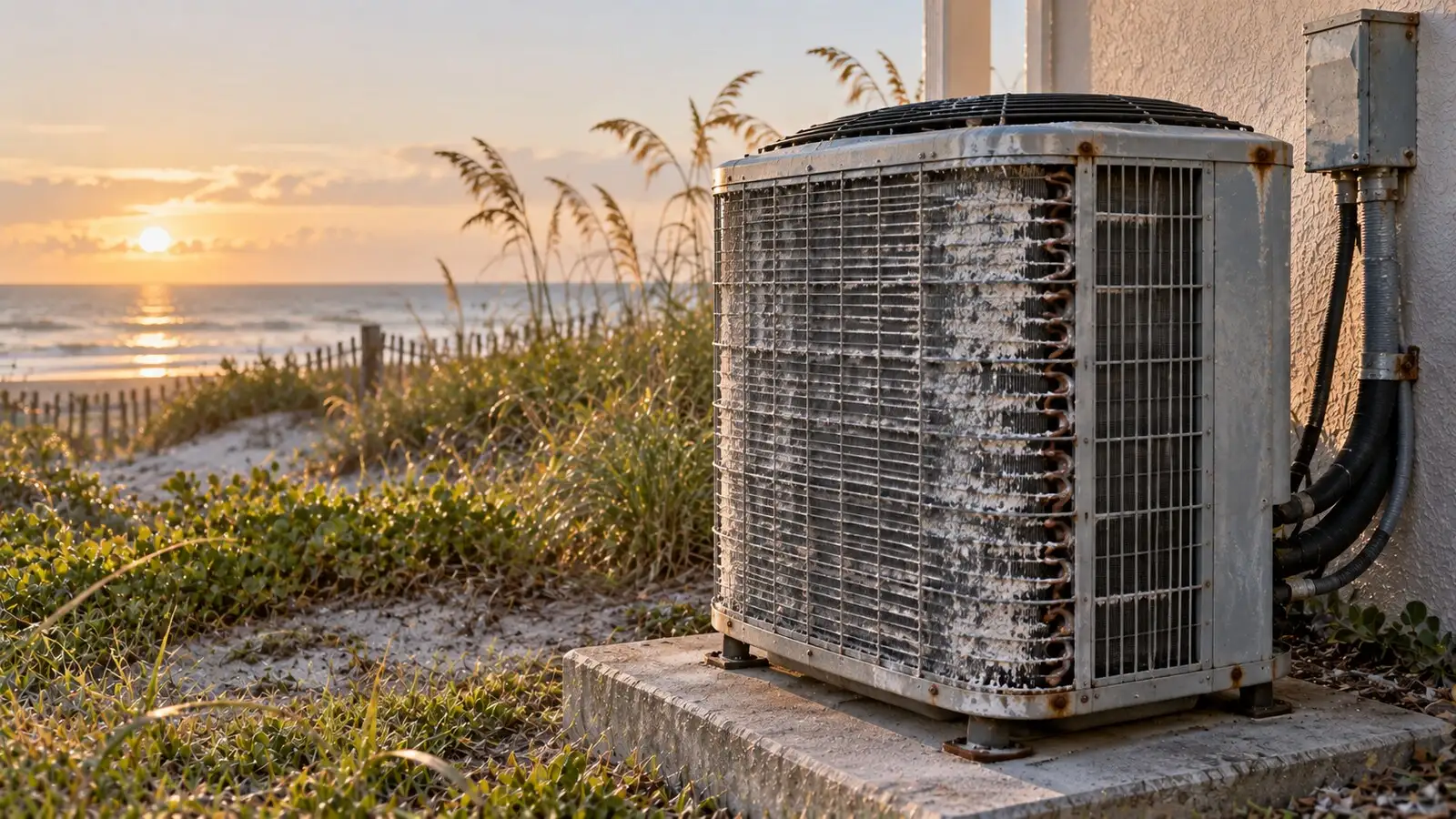
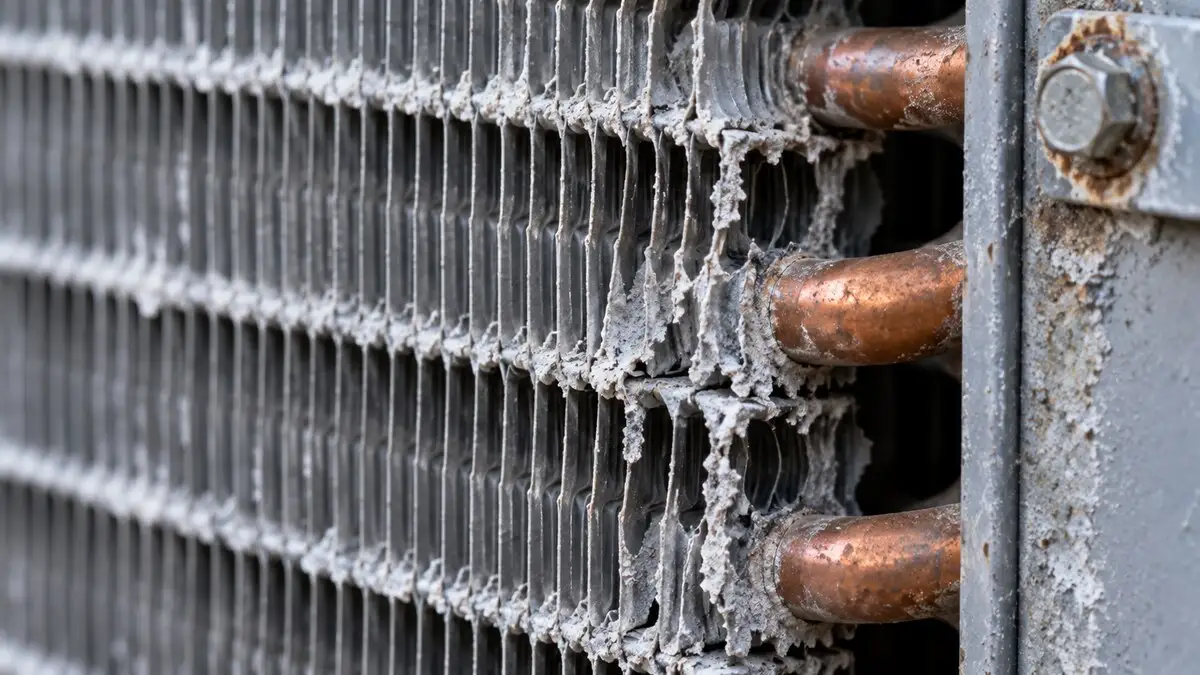
A condenser coil is aluminum fin bonded to copper tube, and both metals share the same wet circuit whenever salt-bearing air settles and holds moisture against the surface. The aluminum goes first. Chloride penetrates the oxide layer that protects it and salt corrosion proceeds as pitting rather than an even film, which is why a coil can look intact and still be losing performance.
The homeowner rarely sees a failure. What they see is a system that used to keep the house at 75 and now manages 78 on an August afternoon, and a power bill that has crept up over three summers. By the time something actually stops, the coil has usually been degrading for years.
The parts that fail before the compressor does
Salt reaches the electrical compartment as readily as the coil, and that is where the calls come from. A damp salt film across capacitor terminals and spade connectors raises resistance, generates heat, and loosens or welds connections. Contactor points pit until they no longer make a clean circuit. Fan mounts and grille fasteners seize. The weatherproof disconnect takes in water and its lugs corrode, producing intermittent faults that imitate a failing compressor.
Distance bands across South Brevard
The geography here turns a gradient into a step, and the Indian River Lagoon is the reason. The lagoon runs roughly a mile and three quarters across at the Melbourne causeway, so the barrier island sits under a mile from the Atlantic while the nearest mainland neighborhoods are already three to four miles from open water. There is almost no gradual middle on the mainland.
- Under a mile: Indialantic and Melbourne Beach at about eight tenths of a mile from the surf
- One to two miles: Satellite Beach and Indian Harbour Beach, with the Banana River on the other side
- Middle band: Merritt Island, four to five miles from the ocean but half a mile from brackish water
- Three to six miles: riverfront Rockledge, Melbourne, West Melbourne
- Seven to ten miles: Viera, Suntree and most of Palm Bay, outside the coastal specifications entirely
What a coastal specification covers
Where the address falls inside those thresholds, the equipment specification changes rather than the maintenance alone. Coated condenser and evaporator coils are the central item, using epoxy or electrodeposited coatings rated against salt spray testing at levels commonly quoted around a thousand hours. Alongside them: corrosion-resistant fasteners and hardware, a line set with an intact ultraviolet-resistant jacket over its insulation, corrosion-resistant hangers and supports, and attention to how the disconnect is sealed.
None of that is exotic, and none of it is expensive relative to the equipment. What it is, on many manufacturers' documents, is a condition of coverage in a coastal location rather than an upgrade, which is why it belongs in the quote before the installation rather than in the conversation after the failure. The installation page covers where it fits in a changeout.
Rinsing, and what it can and cannot do
Rinsing the outdoor coil with fresh water removes chloride before it works through the fin material, and on the island it is the most useful thing a homeowner can do. Use a garden hose at ordinary pressure, work from inside the fin pack outward so deposits are carried out rather than driven deeper, and pull the disconnect first. A pressure washer folds the fins flat and destroys more airflow than the salt would have.
What rinsing cannot do is reverse corrosion that has already separated fin from tube, and it does not reach the electrical compartment, which needs a technician. It also does not remove the interval: a coil rinsed every three months on the island still needs the capacitor, contactor, hardware and disconnect looked at, which is what the maintenance schedule is built around.
When corrosion becomes a replacement
The test is whether the coil still transfers heat. A pack that is dirty but intact responds to cleaning; one whose fins have separated has lost capacity permanently. At that point the arithmetic is the ordinary repair-or-replace one, weighted by a shorter working life on the island: twelve to fifteen years inland, ten to twelve where the air carries salt.
Coastal AC corrosion service by city
- Corrosion Melbourne
- Corrosion Palm Bay
- Corrosion West Melbourne
- Corrosion Rockledge
- Corrosion Merritt Island
- Corrosion Satellite Beach
- Corrosion Indian Harbour Beach
- Corrosion Indialantic
- Corrosion Melbourne Beach
- Corrosion Viera and Suntree
Coastal AC corrosion: common questions
- How close to the water does salt actually matter?
- Closer than most people assume, and the thresholds are written in feet as well as miles. The strictest specifications apply within about a thousand feet of tidal water, with further requirements out to a mile and, on some documents, two. Every address on the barrier island falls inside all of them. Merritt Island sits four to five miles from the ocean but within half a mile of brackish water on both sides, which puts it in a genuine middle band. Nine miles inland in Palm Bay it is not the governing factor.
- Do coil coatings work?
- They work as a barrier and they are worth paying for on the island, but they are not permanent and they are not a substitute for rinsing. Epoxy and electrodeposited coatings are rated against salt spray testing, commonly at a thousand hours, and coated equipment demonstrably outlasts uncoated equipment on this coast. Some coating warranties are themselves conditional on a periodic cleaning regime, so the coating buys years rather than immunity.
- My warranty says nothing about the coast. Am I covered?
- Read the exclusions rather than the coverage. Corrosion damage is commonly excluded unless coated coils, corrosion-resistant hardware and a properly specified line set were part of the original installation, and some manufacturers state a distance from saltwater at which those items become a condition rather than an option. If your house is inside that distance and the equipment installed was standard, a corrosion failure may not be a warranty matter at all. It is a question to settle before installation, not after.
- The fins look gray and powdery. Is that the end of the unit?
- Not necessarily, but it is a measurement question. Aluminum corrodes to a white or gray powder that sits between the fins and blocks airflow before it destroys anything. If the fin is still attached to the tube and the pack still passes air, cleaning and rinsing restores much of the performance. Once fins have separated from the tubes, heat transfer is permanently reduced, and no cleaning brings it back.
- Is a stainless cabinet worth it?
- Cabinet hardware matters more than the cabinet panel. Screws, brackets, the fan motor mount and the grille fasteners are where corrosion first makes a unit unserviceable, because a fastener that has seized or dissolved turns a routine repair into a much longer job. Corrosion-resistant hardware and a coated coil deliver most of the benefit. A fully stainless cabinet is available on some equipment and is a reasonable choice within a few hundred feet of the surf.